When you run a business in Sioux Falls, keeping the building clean takes constant effort, and the floors take the hardest hit. People walk in from the street with dirt on their shoes, moisture tracks in from the parking lot, and over time all of it builds up on the surface. Left alone, that buildup wears down the flooring and can affect the air quality inside the building.
Professional janitorial services are the practical way to stay ahead of that workload. A dedicated crew knows how to handle different floor types and has the tools to pull dirt out before it ends up in the air. This guide walks through why floor care matters and how to handle it correctly in a busy building.
A lot of business owners treat floor care as purely cosmetic. A clean floor does look better to customers, but the condition of your floors also affects the health of the people inside. Dust settles onto carpet, pollen lands on tile, and skin cells and dander collect in the corners. It all works its way down and stays there until something disturbs it.
That something is usually foot traffic. When people walk through, their shoes kick those fine particles back into the air, where employees and customers breathe them in. For sensitive people, that can mean irritated airways and allergy flare-ups.
This connection is well documented. Dr. Anna O’Donovan, a medical author who writes on health and the built environment, made the point in a recent Cleaning & Maintenance Management article, “Healthy Facilities Start From the Floor”: when a building has the right flooring and keeps it properly maintained, crews have a much easier time keeping dust, allergens, and fine particles under control, which helps hold indoor air quality steady in busy buildings.
The takeaway is simple. If your cleaning routine only skims the surface, the deep dirt stays in the floor and the air pays for it. Sweeping alone won’t fix it; it takes methods that actually trap and remove the contaminants.
Where you are matters when you plan a cleaning schedule, and Sioux Falls runs through a wide range of hard weather over a year. Each season brings its own threat to a commercial floor.
Winter is the roughest. The city and private contractors put down a lot of rock salt to keep streets and walks safe, and pedestrians track it straight into your lobby. Salt is abrasive; it acts like sandpaper on a hard floor, scratching the finish and leaving a white, crusty film. On carpet, salt residue works into the fibers, where it can damage them and dull the way the carpet looks.
Spring brings rain and mud. Our soil turns to a thick paste when it’s wet, and once it’s tracked in and dries, it becomes a fine dust overnight that the HVAC system can pull into the vents and spread through the building.
Summer tends to be dry and windy, which blows grit and pollen in through open doors, and any nearby construction adds more. It all settles onto the floors.
Fall adds decaying leaves that stick to shoes and can stain light concrete or tile, and the organic matter breaks down into something bacteria are happy to grow in if it sits.
A single standing mopping routine can’t keep up with all of that. A commercial cleaning plan has to shift with the weather outside the door.
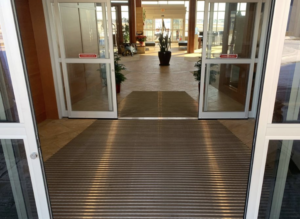
The easiest floor to clean is the one the dirt never reaches, which makes walk-off matting the first line of defense for any building.
A common mistake is a single small mat just inside the front door. One mat doesn’t give shoes enough distance to actually come clean. A proper entrance system usually runs around fifteen feet of matting, in three stages.
It should start outside with a scraper mat, whose rough surface knocks heavy snow and mud off shoes before anyone reaches the door. Just inside comes an absorption mat to pull moisture off shoes and catch melting snow. The last stage is a finishing mat that grabs the fine dust that’s left.
Those mats have to be cleaned daily to keep working. A saturated mat stops absorbing and just hands the water back to the next person, who tracks it onto the hard floor, and a wet hard floor is a real slip hazard. In winter, crews use wet vacuums to pull moisture out of the mats, and they vacuum the dry ones to clear the trapped sand.
Commercial buildings run on all kinds of hard flooring: VCT (vinyl composition tile), luxury vinyl plank, ceramic tile, and polished concrete all show up in Sioux Falls facilities, and each one wants a slightly different approach.
Every hard floor needs daily attention to clear loose soil. Dry dust mops corral the dirt for pickup, but crews should skip oily dust-mop treatments; the oil leaves a sticky film that just pulls in more dirt the next day.
Damp mopping comes next, and a clean mop head is the whole game. A dirty one only spreads muddy water around, which is why crews use two-bucket systems: one bucket for clean solution, one for the dirty water wrung out of the mop. For larger areas, auto-scrubbers lay down clean water, scrub, and vacuum the dirty water back up in a single pass.
VCT carries a coat of wax that protects the tile underneath. Foot traffic wears that wax down and embedded dirt discolors it, so when the floor goes dull, a crew can buff it. The pad spins fast enough that the friction warms the wax and smooths out light scratches, bringing back the shine.
Eventually the old wax has to come off entirely, which is called stripping: a harsh chemical melts the finish, the crew scrapes it up and neutralizes the floor, then lays down fresh coats of wax. It works, but it’s chemical-heavy and labor-heavy.
Newer methods make that easier. Diamond floor pad technology is a solid alternative to the old strip-and-wax routine. The pads carry microscopic diamonds that polish the floor mechanically, using water instead of stripping chemicals, which cuts the chemicals in the building and helps keep a floor’s appearance steady over time.
Carpet is common in offices and medical waiting rooms because it softens sound and makes a space feel warmer. It also works like a large air filter, trapping airborne dust deep in the fibers, which is exactly why it needs regular attention.
Vacuuming is the most frequent task in any carpet care routine, because it lifts dry soil before it settles into the backing. The machine matters, too: a cheap vacuum blows fine dust right back out the exhaust, while a good one filters those particles and keeps them out of the air. Speed matters as well; moving too fast doesn’t give the suction time to pull dirt out of the pile, and busy hallways need several passes.
Spills are a daily fact. Coffee, soda, and food all hit the carpet, and quick action is what keeps a spill from becoming a stain. Crews keep spot kits on hand, blot rather than rub (rubbing frays the fibers and drives the liquid deeper), and match the treatment to the spill, since an organic spill and a grease stain don’t call for the same thing.
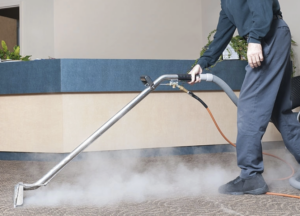
Even with good vacuuming, carpet eventually needs a deep clean, and hot water extraction is the standard. The machine injects hot water and a cleaning agent to break down the soils stuck to the fibers, then a strong vacuum pulls the dirty water back out. Drying quickly afterward is critical; carpet left wet too long can grow mold in the backing, so crews use air movers to speed it up.
Floor care ties directly into safety. Slips and falls are a leading source of injuries in commercial buildings, and neglected floors raise the odds.
A greasy film builds up on a hard floor when the crew mixes the wrong ratio of water to detergent. That residue collects over weeks, and the floor turns slick the moment humidity climbs or someone tracks in a little rain. Doing it right keeps that residue from forming: measure the chemicals accurately, rinse with clean water when it’s needed, and put out wet-floor signs during cleaning.
Damaged flooring is the other hazard. A cracked tile or a lifted carpet seam catches a shoe easily. Regular maintenance is often how those defects get spotted early, so the crew can flag them to the facility manager and get a repair scheduled before anyone gets hurt.
Restroom floors carry the highest risk in any building, since the areas around toilets and urinals collect biological contaminants all day.
Grout is the usual trouble spot. It’s porous, so it soaks up urine and dirty mop water, and that’s what causes the odors an air freshener can’t cover. Proper restroom cleaning uses a disinfectant suited to the floor, and it only works if it’s given its dwell time: the product has to stay wet on the surface for the time its label specifies. Spray it and wipe it right off, and it hasn’t done anything.
A lot of Sioux Falls businesses are switching to tile with epoxy grout. Epoxy grout doesn’t absorb liquid, which makes daily cleaning far more effective and keeps a restroom from holding onto odors.
Plenty of owners try to handle cleaning in-house to save money, usually by asking employees to empty trash or run a vacuum at the end of the day. It rarely holds up.
Staff already have their own jobs, so cleaning becomes the thing they rush through, and details get missed. They also aren’t trained to handle commercial cleaning chemicals, and mixing the wrong ones can create dangerous fumes.
A professional commercial cleaning company takes that off your plate. A dedicated crew works after hours from a checklist built for your building, with commercial-grade equipment most businesses wouldn’t buy on their own. They understand floor chemistry, too, knowing which cleaner is safe on marble and which will ruin it, and how to lift winter salt without stripping the finish.
The payoff runs two ways. A well-maintained floor lasts years longer, which matters because floors are expensive to replace. And keeping dust and allergens down makes for a more comfortable building for the people in it every day.
Keeping a facility clean is an ongoing job. The dirt never stops coming through the front door, so the real goal is a plan that keeps up with your building and the seasons here in South Dakota.
If you’d like help putting that plan together for a building in the Sioux Falls area, request a quote and Optimal Prime Cleaning Services can look at your floors and recommend an approach that fits.
This article is provided by Optimal Prime Cleaning Services for general informational purposes only. It is not legal, compliance, or professional advice for your specific facility. For guidance on your situation, please contact a qualified professional or the relevant authority.