Keeping hard floors in good shape is a constant job for facility managers, and running a building in the Sioux Falls area doesn’t make it easier. Heavy foot traffic, plus the snow, salt, and mud tracked in all winter, is hard on hard surfaces. Most property owners lean on the same routine to keep floors looking acceptable: chemical strippers and coats of wax. There’s a better way worth knowing about.
Diamond floor pad technology has been covered in trade publications like Cleaning & Maintenance Management as an alternative to traditional floor care. Instead of harsh chemicals, it relies on mechanical polishing. That shift can cut the amount of chemicals in a building, save labor, and keep floors looking consistent year-round.
Traditional hard floor care runs on a cycle of applying finish and stripping it back off. Crews put down several coats of acrylic wax to protect vinyl, concrete, or terrazzo. The wax is a sacrificial layer, so dirt and grit scratch it instead of the floor itself.
Over time, the wax breaks down. Sunlight yellows it, embedded dirt dulls it, and eventually the floor needs a full strip and re-wax to look right again. That’s where the inefficiency shows up.
The crew spreads a chemical stripper, waits for it to react, then runs floor machines with abrasive pads to scrape up the softened wax. That leaves a slurry of old wax and chemicals to vacuum up, followed by several rinses, since any leftover stripper will ruin the new finish. Then come four to six fresh coats of wax, each needing time to dry before the next.
All of that is a lot of labor. It usually means closing off sections of a building for a full weekend, and the chemical odors can linger in the HVAC system. And it repeats, year after year.
Diamond pads do away with chemical strippers. They look a lot like ordinary floor-machine pads, but they’re made with microscopic industrial diamonds embedded in them.
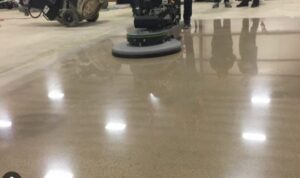
Diamond is the hardest natural material there is. Attached to a floor buffer or an auto-scrubber, those tiny diamonds act like microscopic cutting tools, cleaning and polishing the floor mechanically with plain water instead of detergent.
The process works through grits, a lot like sanding. A coarse pad cuts away the top layer of damaged wax or soil. A finer pad smooths out the scratches from the first pass. A fine polishing pad finishes with a high-gloss surface. Because it’s physical abrasion rather than a chemical reaction, the result is immediate. The floor is clean and shiny as the machine passes, with no dry time before it’s back in use.
Labor is the most expensive part of any cleaning contract, so anything that saves time matters.
Diamond pads fold into daily maintenance instead of being a separate event. The crew attaches the right pad to the auto-scrubber they already use, and it cleans and polishes in the same pass. No scheduling weekend strip-and-wax jobs, no overtime for them, and no managing stripper inventories or disposing of wax slurry.
The equipment is simple, too. Diamond pads run on the same low-speed buffers and auto-scrubbers most crews already own, so there’s no specialized machinery to buy.
Cutting chemical use is a priority for a lot of facilities. Traditional floor strippers contain volatile organic compounds that evaporate at room temperature and end up in the indoor air.
Occupants notice the smell, and for some people those fumes can be bothersome or bring on headaches and airway irritation. Anyone with asthma tends to be more sensitive to airborne chemicals. Switching to diamond pads takes those chemicals out of the process, since it runs on water. That’s easier on employees and customers, and on the cleaning crew, who aren’t handling caustic liquids or breathing fumes through a shift.
Lorem ipsum dolor sit amet, consectetur adipiscing elit. Ut elit tellus, luctus nec ullamcorper mattis, pulvinar dapibus leo.
Keeping hard floors in good shape is a constant job for facility managers, and running a building in the Sioux Falls area doesn’t make it easier. Heavy foot traffic, plus the snow, salt, and mud tracked in all winter, is hard on hard surfaces. Most property owners lean on the same routine to keep floors looking acceptable: chemical strippers and coats of wax. There’s a better way worth knowing about.
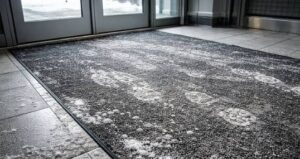
South Dakota weather is tough on floors, and winter is the worst of it. Snowplows and contractors spread heavy rock salt and de-icers across lots and sidewalks, and customers track it right inside.
Salt is hard on acrylic wax. It scratches the surface and can leave white, cloudy stains, and a mop and bucket won’t fix it, because the mop water just spreads the salt around. Diamond pads handle it better. Run over salt-damaged VCT or polished concrete, the diamonds cut the staining away and smooth the scratches, bringing the floor back without a full chemical strip.
Spring adds mud and summer adds windblown dust. The mechanical action lifts that grit out of the floor’s pores, and the auto-scrubber’s vacuum pulls the dirt and water up, so it doesn’t build up and wear the floor down.
Switching methods pencils out. A diamond pad costs more up front than a nylon pad, but it lasts far longer and covers a lot of floor before it wears out.
The bigger savings are in labor and chemicals. You drop the budget for strippers, neutralizers, and finish, and you stop paying the heavy labor hours a strip job takes.
Your floors also last longer. Harsh strippers, and the heavy water that comes with them, break down the adhesive holding vinyl tile to the subfloor. Over time, tiles curl, lift, and let moisture underneath where mold can grow. Skip the flooding, and you protect the floor itself, and push out the big expense of tearing it out and replacing it.
Getting this right takes a commercial cleaning partner who knows the method. A crew used to old habits can get it wrong, with the wrong grit sequence or the wrong machine speed, so the provider needs to train staff on the equipment and know how to read a floor to pick the right starting pad.
Local knowledge helps, too. A Sioux Falls cleaning company knows the soils and the weather here, and how much salt really comes through a lobby in January. Every building is different, too. Polished concrete in a warehouse isn’t maintained on the same schedule as VCT in a clinic, so a good provider assesses your specific floors and sets the right frequency.
At Optimal Prime Cleaning Services, we look at the condition and type of each floor before deciding on a maintenance approach. If you want to move away from the strip-and-wax cycle, request a quote and we can go over whether diamond pad maintenance is a fit for your building.
*This article is provided by Optimal Prime Cleaning Services for general informational purposes only. It is not legal, compliance, or professional advice for your specific facility. For guidance on your situation, please contact a qualified professional or the relevant authority.*