How to Disinfect and Sanitize Public Areas

Your facility may look clean, but if it hasn’t been disinfected, the surfaces people touch all day could still be harboring germs. Lowering the risk of illness at work means adding a real emphasis on disinfection, not just cleaning.

One thing worth keeping in perspective: respiratory viruses like the flu and COVID-19 spread mainly through the air, so disinfection works best alongside good ventilation and hand hygiene rather than on its own. That said, keeping high-touch surfaces disinfected is still a genuine part of reducing spread. The best move is to reach out to us for help building a cleaning and disinfecting program, but for starters, these seven tips will get you going.

Clarify Your Goals

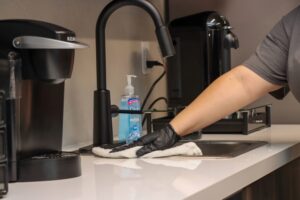
A cleaner disinfecting a countertop in a Sioux Falls workplaceMost facility cleaning focuses on the dirtiest, most visible areas. When we say “cleaning,” we usually mean physically removing dirt and dust, mopping floors, wiping splatter, handling spills.

But to control the microbes that actually cause illness, the CDC recommends a two-step process: use a detergent-based cleaner to physically remove dirt from a surface, then follow with a separate EPA-registered disinfectant to kill the germs left behind. That means paying attention to surfaces that don’t look dirty at all. The CDC advises routinely disinfecting every frequently touched surface, door handles, machinery control panels, even the breakroom TV remote.

Keep in mind: time is not a disinfectant. One study of pandemic H1N1 flu, published in the American Journal of Infection Control, found the virus stayed infectious for up to 48 hours on wood, about 24 hours on stainless steel and plastic, and roughly 8 hours on cloth. Other research has found flu can decay faster than that, but the practical takeaway is the same, a contaminated surface can stay contaminated until it’s disinfected.

2. Protect Your Crew

When your cleaning staff focus on high-touch areas, they’re also exposed to the germs they’re working to remove. The CDC advises strict PPE protocol to protect cleaning crews. Keep gloves and eye protection readily available, and reinforce training on putting protective equipment on and taking it off safely.

3. Design for Hygiene

Over time, design choices make disinfecting easier. For hard, non-porous surfaces, the CDC advises cleaning visibly dirty spots before disinfecting, then using an EPA-registered disinfectant suited to those surfaces. In high-traffic areas, consider whether soft, porous materials can be reduced, and clean the ones that stay with appropriate products.

Pathogens also collect in hard-to-clean crevices, so replace chipped or cracked fixtures promptly, they’re very hard to disinfect. When you’re choosing new door handles or equipment controls, favor simple designs with large, flat, smooth faces that wipe clean in a single pass.

4. Clear the Air

Your HVAC system plays a bigger role in hygiene than people realize. According to ASHRAE, the ventilation and filtration an HVAC system provides can reduce the airborne concentration of viruses, and the organization recommends HEPA filtration to cut airborne pathogens in healthcare settings. Some research also suggests that maintaining moderate indoor humidity can shorten how long droplet-borne viruses survive. Better ventilation and filtration go a long way.

5. Involve Everyone

The CDC recommends encouraging good hygiene across your workforce to keep germs off surfaces in the first place. You may not be able to run a strict glove regimen, but you can encourage people to keep their hands clean and wipe down their own workstations through the day.

Keep sinks well stocked with soap and hand towels, consider adding alcohol-based sanitizer stations around the building, and keep disinfecting wipes at workstations so employees can wipe frequently touched surfaces before and after each shift.

6. Pick Up the Pace

Frequent disinfection lowers your team’s potential exposure. As the focus shifts from cleaning to disinfecting, it’s worth increasing how often high-touch surfaces get disinfected, attending to them between shift changes can help slow the spread of illness.

7. Read the Label

Finally, use the right disinfectant the right way. The EPA’s List N includes hundreds of products qualified for use against viral pathogens, with active ingredients ranging from citric acid to quaternary ammonium. They’re all effective disinfectants, but swabbing a surface isn’t enough on its own, follow the product’s directions and give it time to work. Many products need the surface to stay wet for several minutes.

When you bring in a new disinfectant, stay in compliance with OSHA’s hazard communication requirements, some cleaning chemicals are caustic or toxic and call for extra PPE. And make sure the product is compatible with your surfaces; some strong disinfectants can discolor or damage hard plastics.

The bottom line: protecting your workforce means treating cleaning as more than mopping up what you can see. It’s about handling the contamination you can’t see, before it spreads.

If you’d like help building a disinfection program for your commercial building, request a quote and Optimal Prime Cleaning Services will put together a plan for your Sioux Falls facility.

The information in this article is for general informational purposes only and is based on information available as of the original publication date. No representation is made that it is complete or remains current. It is not a substitute for reviewing current government regulations, industry standards, or standards specific to your business, and it should not be taken as legal advice. For specific questions, consult the applicable standards or an attorney.

WordPress Appliance - Powered by TurnKey Linux